EO-1#
← Tutorial Library · policies and Models
This section introduces the general functions of LeRobot. Please configure the example according to the target robot, data set and operating environment; before using it with AlohaMini 2 / 2 Pro, you need to confirm the hardware and interface compatibility.
EO-1 is a Vision-Language-Action policy for robot control. The LeRobot implementation integrates EO-1 with the standard LeRobot training, evaluation, processor interface.
Model Overview#
EO-1 uses a Qwen2.5-VL backbone for vision-language understanding and adds a continuous flow-matching action head for robot control. The policy formats each robot-control sample as a multimodal conversation: camera images are passed to Qwen2.5-VL, the robot state is represented with EO-1 state tokens, and the future action chunk is represented with EO-1 action tokens.
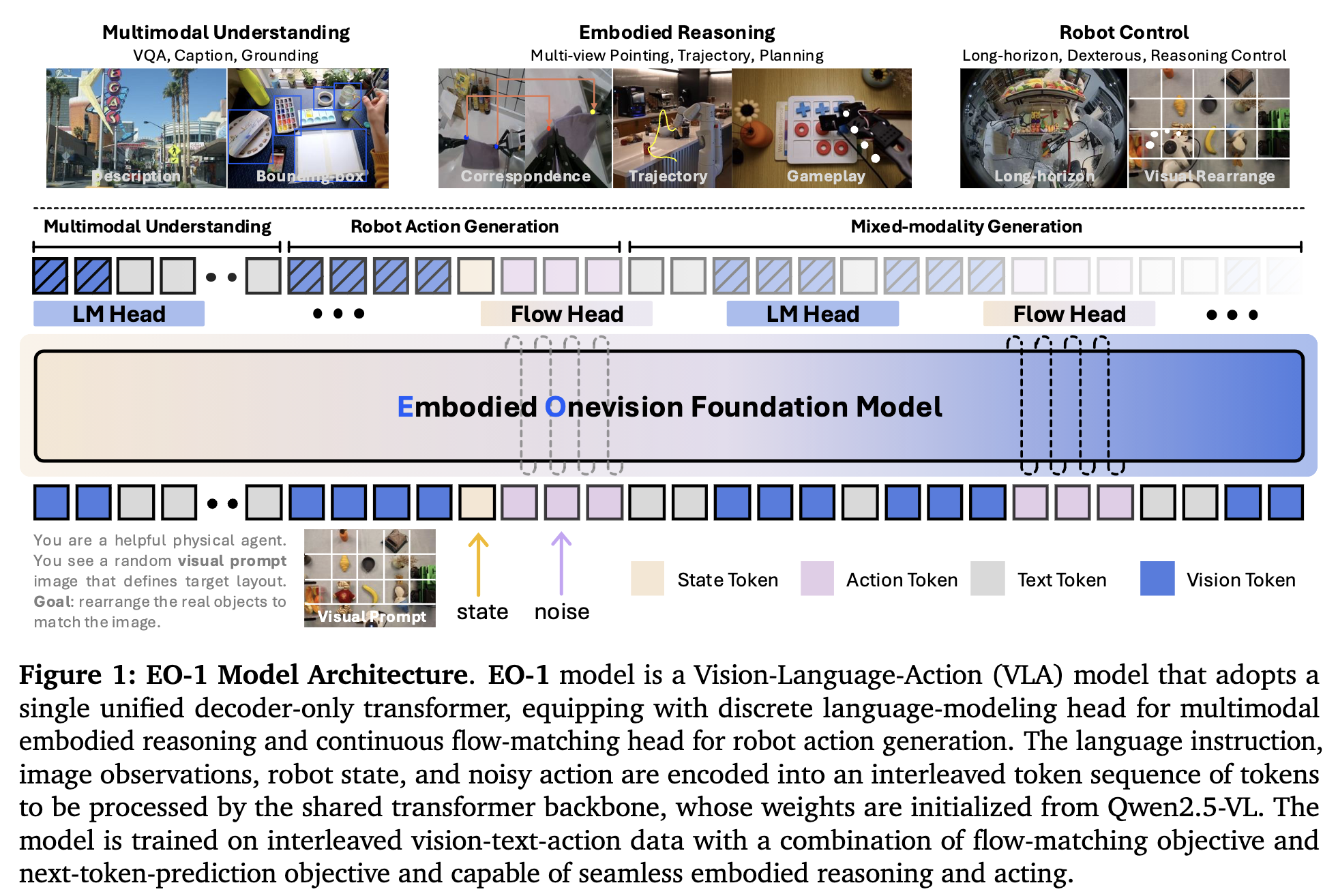
During training, EO-1 learns to denoise continuous action chunks at the action-token positions. During inference, it samples an action chunk, returns continuous actions, and executes n_action_steps from the chunk before sampling again.
What the LeRobot Integration Covers#
Standard
policy.type=eo1configuration through LeRobotQwen2.5-VL image and text preprocessing through policy processors
Continuous flow-matching action prediction
Checkpoint save/load through LeRobot policy APIs
Training with
lerobot-trainand evaluation withlerobot-eval
The broader EO-1 project also includes interleaved vision-text-action pretraining and multimodal reasoning workflows. This page focuses on the LeRobot robot-control policy path.
Installation Requirements#
Install LeRobot by following the Installation Guide.
Install EO-1 dependencies by running:
pip install -e ".[eo1]"
If you want to train or evaluate on LIBERO, install the LIBERO dependencies too:
pip install -e ".[eo1,libero]"
EO-1 can use the standard PyTorch scaled-dot-product attention backend through policy.attn_implementation=sdpa. If your environment has a compatible flash_attn installation, you can request policy.attn_implementation=flash_attention_2.
Data Requirements#
EO-1 expects a LeRobot dataset with:
At least one visual observation, for example
observation.images.imageobservation.stateactionA language task instruction through the dataset
taskfield
If your dataset uses different observation names, use rename_map to align them with the names expected by your training or evaluation setup.
Usage#
To use EO-1 in a LeRobot configuration, specify the policy type as:
policy.type=eo1
By default, a new EO-1 policy initializes its backbone from:
policy.vlm_base=Qwen/Qwen2.5-VL-3B-Instruct
Once a LeRobot-format EO-1 checkpoint is available, load it with:
policy.path=your-org/your-eo1-checkpoint
Training#
Training Command Example#
lerobot-train \
  --dataset.repo_id=your_org/your_dataset \
  --policy.type=eo1 \
  --policy.vlm_base=Qwen/Qwen2.5-VL-3B-Instruct \
  --policy.dtype=bfloat16 \
  --policy.attn_implementation=sdpa \
  --policy.gradient_checkpointing=false \
  --output_dir=./outputs/eo1_training \
  --job_name=eo1_training \
  --steps=300000 \
  --batch_size=16 \
  --policy.device=cuda
Key Training Parameters#
Parameter |
Default |
Description |
|---|---|---|
|
|
Qwen2.5-VL checkpoint used to initialize a new policy |
|
|
Backbone dtype request: |
|
|
Optional Qwen attention backend, such as |
|
|
Reduces memory usage during training |
|
|
Number of future actions predicted per chunk |
|
|
Number of actions consumed from a sampled chunk |
|
|
Number of flow-matching denoising steps used during sampling |
|
|
State padding dimension |
|
|
Action padding dimension |
|
|
Keeps the flow head in fp32 even when the backbone uses mixed precision |
|
|
Controls whether padded action dimensions are supervised |
|
|
Controls whether padded future action rows are supervised |
Evaluation#
EO-1 can be evaluated through lerobot-eval once you have a LeRobot-format checkpoint:
lerobot-eval \
  --policy.path=your-org/your-eo1-checkpoint \
  --env.type=libero \
  --env.task=libero_object \
  --eval.batch_size=1 \
  --eval.n_episodes=20
For datasets or environments whose camera names differ from the checkpoint configuration, pass a rename_map:
lerobot-eval \
  --policy.path=your-org/your-eo1-checkpoint \
  --env.type=libero \
  --env.task=libero_object \
  --rename_map='{"observation.images.image2":"observation.images.wrist_image"}'
Configuration Notes#
Image Processing#
EO-1 uses the Qwen2.5-VL processor. The policy.image_min_pixels and policy.image_max_pixels settings control the image resizing bounds before the visual tokens are passed into the backbone.
State and Action Dimensions#
The policy pads state and action vectors to policy.max_state_dim and policy.max_action_dim before the EO-1 flow head. Predictions are cropped back to the original action dimension before being returned by the policy.
Attention Backend#
Use policy.attn_implementation=sdpa for a portable setup. Use flash_attention_2 only when flash_attn is installed and compatible with your environment.
References#
Citation#
@article{eo1,
  title={EO-1: Interleaved Vision-Text-Action Pretraining for General Robot Control},
  author={Delin Qu and Haoming Song and Qizhi Chen and Zhaoqing Chen and Xianqiang Gao and Xinyi Ye and Qi Lv and Modi Shi and Guanghui Ren and Cheng Ruan and Maoqing Yao and Haoran Yang and Jiacheng Bao and Bin Zhao and Dong Wang},
  journal={arXiv preprint},
  year={2025},
  url={https://arxiv.org/abs/2508.21112}
}
License#
This LeRobot integration follows the Apache 2.0 License used by LeRobot. Check the upstream EO-1 model and dataset pages for the licenses of released EO-1 checkpoints and data.