WALL-OSS#
← Tutorial Library · policies and Models
This section introduces the general functions of LeRobot. Please configure the example according to the target robot, data set and operating environment; before using it with AlohaMini 2 / 2 Pro, you need to confirm the hardware and interface compatibility.
WALL-OSS is an open-source foundation model for embodied intelligence, proposed by the XSquare Robot team in 2025. The LeRobot implementation is adapted from their open-source WallX repository.
X Square Robot’s WALL-OSS is now integrated into Hugging Face’s LeRobot ecosystem. This is an exciting collaborative project between the LeRobot and X Square Robot teams. You can now post-train, evaluate, and deploy WALL-OSS directly through LeRobot. With this, we’re aiming to make it easier for the open-source robotics community to customize and deploy WALL-OSS foundation models. Read and explore WALL-OSS paper and code.
Model Overview#
The WALL-OSS team is building the embodied foundation model to capture and compress the world’s most valuable data: the continuous, high-fidelity stream of physical interaction. By creating a direct feedback loop between the model’s decisions and the body’s lived experience, the emergence of a truly generalizable intelligence is enabled—one that understands not just how the world works, but how to act effectively within it.
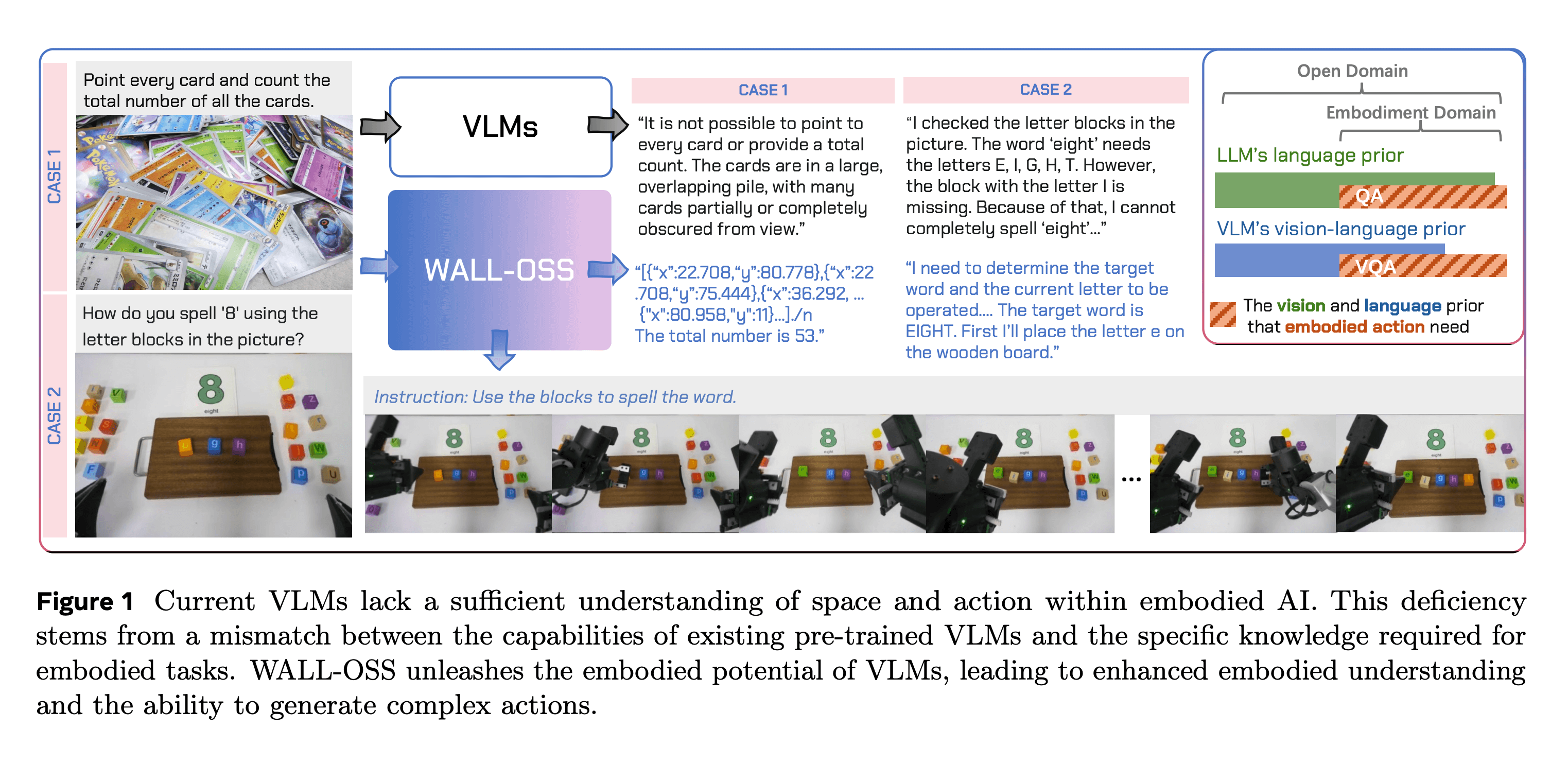
Technically, WALL-OSS introduces a tightly coupled multimodal architecture (tightly-coupled MoE structure) that integrates both discrete and continuous action modeling strategies. Through a two-stage training pipeline (Inspiration → Integration), the model gradually unifies semantic reasoning and high-frequency action generation. Its core innovations include:
Embodied perception–enhanced multimodal pretraining: Large-scale training on unified vision–language–action data to strengthen spatial, causal, and manipulation understanding.
Unified Cross-Level Chain-of-Thought (Uni-CoT): A single differentiable framework that unifies high-level instruction reasoning, sub-task decomposition, and fine-grained action synthesis, forming a continuous chain from “understanding” to “execution.”
Mixture-of-Experts (MoE) action heads: Dynamically activating experts depending on the task phase and modeling actions in discrete or continuous space to maintain stable VLM priors.
Two-stage training paradigm:
Inspiration stage: Injecting discrete action priors to strengthen spatial understanding and semantic-action alignment.
Integration stage: Using flow matching to achieve high-frequency continuous control.
Installation Requirements#
Install LeRobot by following our Installation Guide.
Install WallX dependencies by running:
pip install -e ".[wallx]"
Usage#
To use WallX in LeRobot, specify the policy type as:
policy.type=wall_x
Training#
For training WallX, you can use the standard LeRobot training script with the appropriate configuration:
lerobot-train \
    --dataset.repo_id=your_dataset \
    --policy.type=wall_x \
    --output_dir=./outputs/wallx_training \
    --job_name=wallx_training \
    --policy.repo_id=your_repo_id \
    --policy.pretrained_name_or_path=x-square-robot/wall-oss-flow \
    --policy.prediction_mode=diffusion \
    --policy.attn_implementation=eager \
    --steps=3000 \
    --policy.device=cuda \
    --batch_size=32
Training Arguments#
Argument |
Description |
|---|---|
|
The Hugging Face Hub repository ID for your training dataset (e.g., |
|
Specifies using the WallX policy architecture |
|
Local directory where training checkpoints and logs will be saved |
|
A name identifier for this training run (used in logging/tracking) |
|
Your Hugging Face Hub repo ID where the trained model will be pushed |
|
Path to pretrained WallX weights to initialize from (the official WALL-OSS checkpoint) |
|
The action prediction strategy: |
|
Attention implementation backend - |
|
Total number of training steps to run |
|
Device to train on ( |
|
Number of samples per training batch |
License#
This model follows the Apache 2.0 License, consistent with the original WallX repository.