AlohaMini product description (for K12 education)#
1. The era of “embodied intelligence” is coming#
On July 17, 2026, President Xi Jinping attended the opening ceremony of the 2026 World Artificial Intelligence Conference and High-level Conference on Global Governance of Artificial Intelligence in Shanghai and delivered a keynote speech.

Focusing on the development and governance of artificial intelligence, President Xi Jinping put forward four opinions:
Adhere to openness and win-win | Strengthen risk awareness | Encourage inclusiveness | Advocate working together as one heart
Among them, in terms of “adhering to openness and win-win and driving innovative development”, President Xi Jinping emphasized:
Artificial intelligence is the new engine of world economic growth and the accelerator of the conversion of old and new kinetic energy. It is moving from the “digital world” to the “physical world”. Seize this rare historic opportunity, encourage open source, cooperation and sharing, comprehensively promote artificial intelligence technological innovation, industrial development, and scenario applications, and coordinately promote the transformation and upgrading of traditional industries, the cultivation and growth of emerging industries, and the forward-looking layout of future industries, so that artificial intelligence can empower thousands of industries. Full text of the speech on CCTV.com
Artificial intelligence is moving from the “digital world” to the “physical world”.
Large models represented by ChatGPT, DeepSeek, Doubao, etc. can already understand language, images and knowledge.
Embodied intelligence (Embodied AI) gives artificial intelligence further the ability to perceive and act: it can see the environment, understand tasks, control robots to complete operations such as movement, grabbing, and placement, and continuously learn and improve in real scenes.
Numerical Ability Able to speak | Able to see | Able to reason
↓
Embodied ability Able to perceive|Able to act|Able to operate|Able to solve real problems
At present, embodied intelligence has become a key future industry laid out by the country The “15th Five-Year Plan Outline” has included embodied intelligence as a key future industry direction.
Data from the State Administration of Taxation show that from January to May 2026, my country’s embodied intelligence industry maintained rapid growth:
Domain |
Year-on-year growth |
|---|---|
Sales revenue of embodied intelligence industry companies |
22.40% |
Robot body and robot manufacturing |
30.10% |
AI algorithm and software integration |
24.50% |
System integration and industry applications |
27.90% |
View industry data from the State Administration of Taxation
During the same period, the total amount of embodied intelligent robots purchased by industrial enterprises increased by 2.3 times year-on-year, reflecting that the integration of embodied intelligent robots and industrial production continues to deepen. As technology moves from laboratories to factories, services and more real-life scenarios, the industry no longer needs technical talents in a single field, but comprehensive talents who can understand artificial intelligence, robot ontology, visual perception, data training and scenario applications.
Embodied intelligence integrates multiple capabilities such as artificial intelligence, robotics, mechanical structure, computer vision, data training and real-life scenario applications. In the 2026 special action for real-life training of humanoid robots and embodied intelligence, the Ministry of Industry and Information Technology and the State-owned Assets Supervision and Administration Commission of the State Council clearly proposed to cultivate “diversified and compound talents who not only master core technologies but are also proficient in industry scenario applications” and accelerate the construction of an industrial talent echelon.
Talent training must be oriented to the future of the industry, and seeds must be sown from the basic education stage.
Students not only need to be able to use artificial intelligence tools, but also need to understand how artificial intelligence perceives, learns, makes decisions and acts.
Allowing students to carry out observation, manipulation, data collection, model training and task verification on real robots is an important step in artificial intelligence education from “recognizing technology” to “creating technology”.
2. Current status of K12 embodied intelligence education#
In recent years, artificial intelligence, programming and robotics education have gradually entered primary and secondary school classrooms, clubs and scientific and technological activities. Through graphical programming, intelligent hardware construction, robot control and project practice, students begin to understand how algorithms, sensors and automation technologies affect real life.
Robotics and artificial intelligence competitions also provide students with a stage for display, communication and continuous practice. The Ministry of Education announced a total of 47 national competitions for primary and secondary school students in the 2025-2028 school year. Among them, natural science literacy competitions have covered many directions such as artificial intelligence, robots, drones, inventions and creations. Ministry of Education list
The following are representative competitions that are more directly related to the practice of robotics and artificial intelligence:
Event |
Main practice direction |
Core experiences available to students |
|---|---|---|
National Youth Artificial Intelligence Innovation Challenge |
Artificial Intelligence Application, Intelligent Hardware and Innovation Practice |
Starting from the problem, using artificial intelligence technology to design solutions |
World Robot Conference Youth Robot Design and Information Literacy Competition |
Robot design, programming, information literacy and task challenges |
Build, program, and control robots to complete designated tasks |
National Youth Drone Competition |
Aircraft control, programming and engineering practice |
Understand intelligent flight, automatic control and engineering collaboration |
The First National Youth Artificial Intelligence Competition |
Artificial intelligence foundation, tool application, scientific research, embodied intelligence and large language model application |
From the use of artificial intelligence tools to further model training and real-life scenario practice |
Together, these competitions form an important practical ecosystem for K12 artificial intelligence and robotics education: students can get started with programming, construction and control, and gradually move into intelligent hardware, artificial intelligence applications and technological innovation projects.
From “controlling robots” to “letting robots learn” is a new capability upgrade
Traditional robot learning and competition usually focus on construction, programming, path planning, sensor control and fixed task execution. These abilities are still important and are the basis for students to enter artificial intelligence and engineering practice.
Embodied intelligence further raises new questions: robots must not only execute pre-written instructions by humans, but also be able to perceive the environment, understand tasks, gain experience from human demonstrations, and take actions in real environments.
This change can be understood as:
Traditional robot practice Build a robot → write a program → perform specified actions
↓
Embodied Intelligence Practice Observe the environment → Demonstrate with people → Collect data → Model learning → Act with real machines → Continuous improvement
This is not to replace traditional robotics education, but to build on it and further expose students to the cutting-edge direction of combining artificial intelligence with the real physical world.
The embodied intelligent track provides K12 students with a future-oriented real practice outlet
The first National Youth Artificial Intelligence Competition has five cutting-edge tracks: basic knowledge of artificial intelligence, application of artificial intelligence tools, artificial intelligence-driven science, embodied intelligence and large language model application. Among them, the unique feature of track four, “Youth Embodied Intelligence Competition” is that it not only tests whether students can control robots to complete tasks, but also tests whether students can make robots “learn” and “act” in real scenes.
The competition uses “micro supermarket pickup and checkout” as the application scenario, and adopts the competition method of “online simulation + offline real machine”. Students need to complete environmental understanding, teleoperation demonstration, data collection, model training, simulation debugging, deployment on the robot and on-site testing. Track Four Finals Guide
Therefore, this track does not correspond to a single robot operation capability, but a complete embodied intelligence practice link:
Understand the task → Teach the robot to demonstrate → Collect real data → Train or call the model → Verify on the real machine → Based on the results Continuous improvement
Judging from the currently public whitelist competitions and competition rules, the first National Youth Artificial Intelligence Competition is not the oldest robotics competition; however, it has a distinct cutting-edge positioning: It uses “embodied intelligence” as an independent track and clearly combines models, data, simulation and real machine practice. At the same time, it is also the first natural science literacy whitelist competition to be settled in Shanghai. The finals brought together 856 contestants from 31 provinces, autonomous regions, municipalities directly under the Central Government, Xinjiang Production and Construction Corps, and Hong Kong and Macao. Shanghai Municipal Government Report
AlohaMini enables schools to turn “cutting edge” into daily practice
Aloha Mini is used as the competition machine for the “Youth Embodied Intelligence Competition” in the final track of the first National Youth Artificial Intelligence Competition. It provides schools with a unified platform that connects daily teaching, club activities, research learning and competition training.
Students can first learn how to teach robots to complete tasks through shaking operations, and then further complete data collection, model training and real machine verification; teachers can continue to carry out courses, club projects, research and competition preparations around the same device.
The significance of AlohaMini is not only to help students participate in an event, but also to enable schools to carry out future-oriented embodied intelligence practices in advance: allowing students to gradually move from “controlling robots” to “understanding how robots learn”, and try to create new possibilities with real data and real tasks.
3. AlohaMini Product Description#
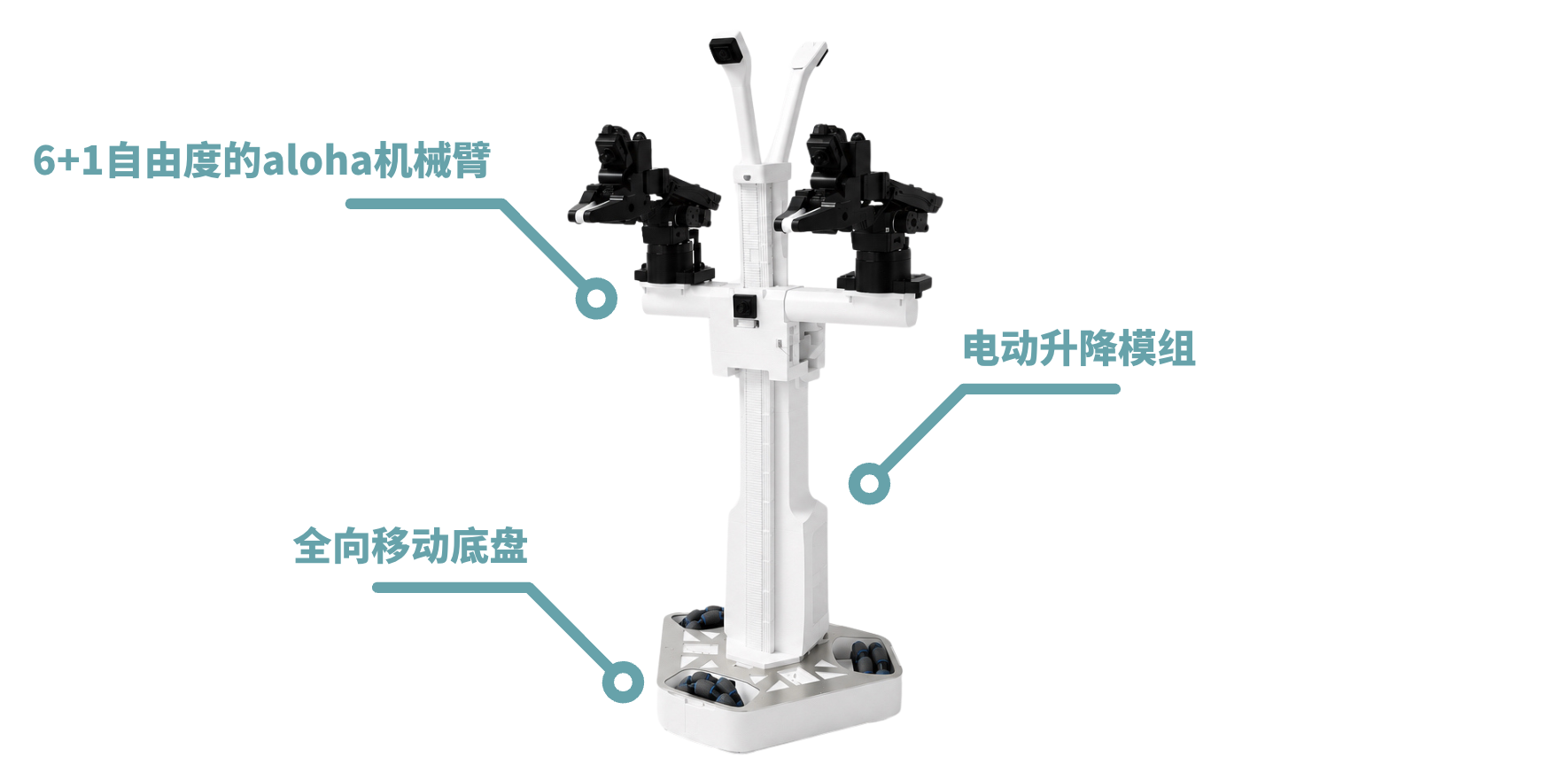
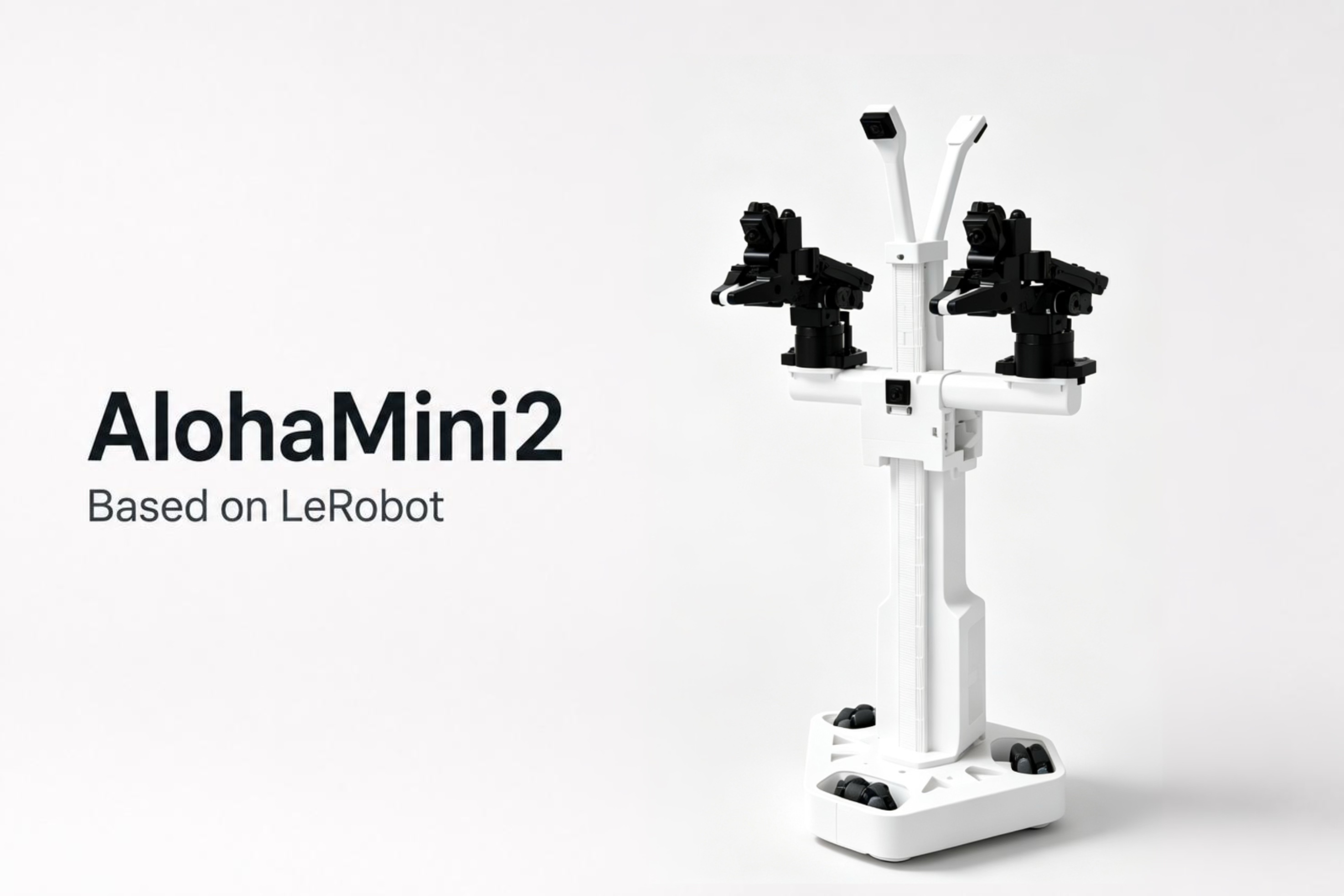
AlohaMini is a two-arm movable lifting robot designed for embodied intelligent science education, student project research, club activities and competition practice.
Hardware configuration: What tasks can the Aloha Mini do?#
AlohaMini integrates movement, lifting, dual-arm operation and visual perception capabilities and can support students to design, train and verify different tasks around real-life and campus problems.
Desktop operations: Organize stationery, classify building blocks, place experimental materials, and accurately place items into designated containers.
Low pick-up: Pick up items from the ground or a lower location, and then place them on the desktop, storage shelf or designated area.
Two-arm collaboration: One robotic arm fixes the object, and the other robotic arm completes the operation; it can also continuously complete multi-step tasks such as “taking - moving - placing”.
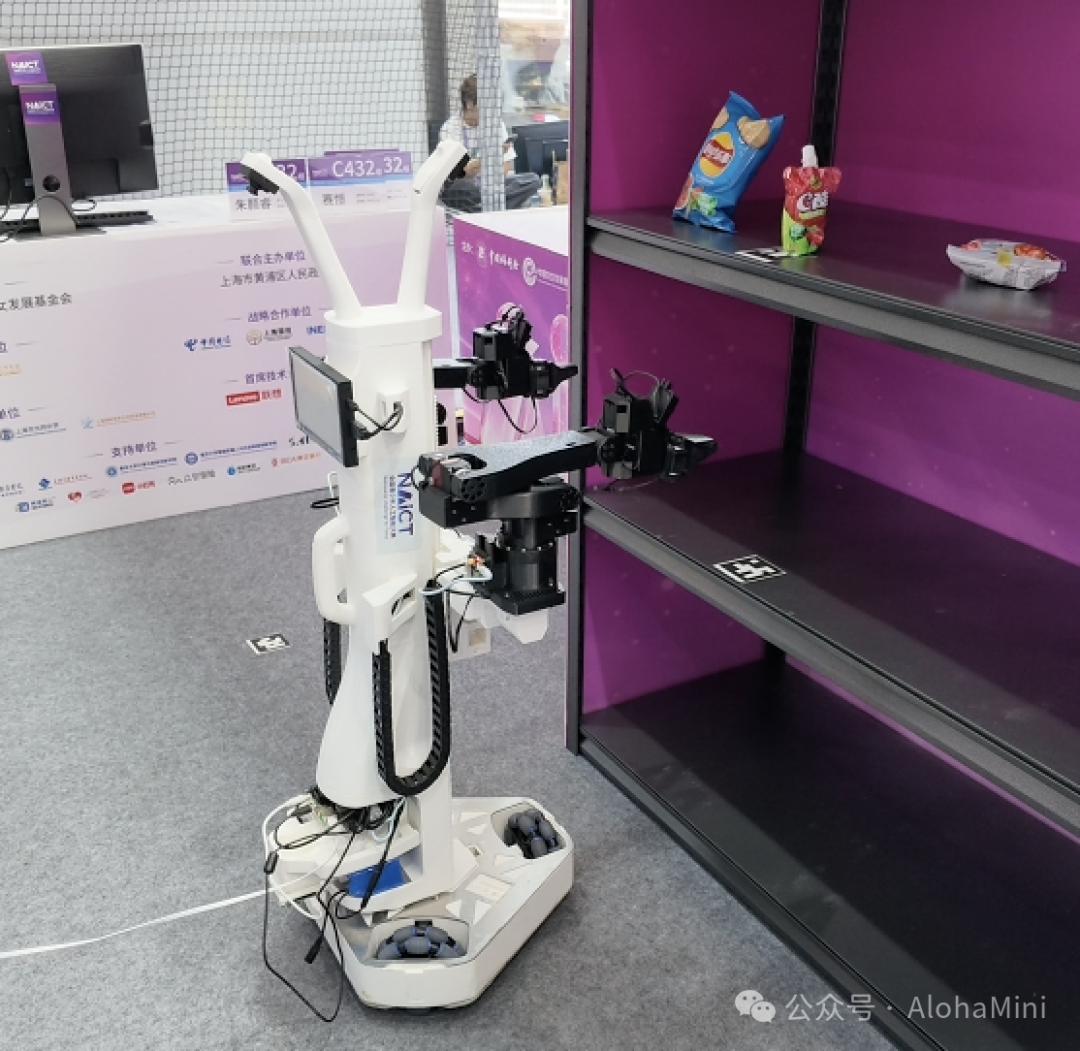
Mobile pick-and-place: In a simulated supermarket, laboratory or campus service scenario, the robot moves autonomously to a designated area, identifies target items, and completes grabbing, transfer and delivery.
Scenario innovation: Students can independently build scenarios based on campus life, such as “smart supermarkets”, “experimental equipment sorting”, “book delivery”, “garbage classification”, “material sorting”, etc.
For example:
At the finals of the Embodied Intelligence Track of the First National Youth Artificial Intelligence Competition, participating students carried out practice around the task of “smart supermarket shopping”: AlohaMini moved from the starting point to the target shelf area, located the target product through visual recognition, and then used its arms to complete grabbing and transfer, and accurately placed the product to the delivery area.
Imitation learning: How does the AlohaMini learn to act autonomously?#
Imitation learning is currently one of the important methods for robots to acquire real operating capabilities.
Unlike traditional robots that repeat actions according to a fixed program, imitation learning allows robots to learn tasks from human demonstrations.
It can be understood as the process of students learning a new skill:
First observe what the teacher does ➡️ Practice repeatedly ➡️ Complete independently
The same goes for robots:
Once a person demonstrates, the robot learns once; by continuously increasing real experience, the robot will have the opportunity to do the task better
AlohaMini helps students understand how robots can gradually move from being “controlled by humans” to “acting autonomously” through the following process:
Shake operation demonstration → Data collection → Model training or inference → Real machine verification → Iterative optimization
Step One: Shake Operation Demonstration
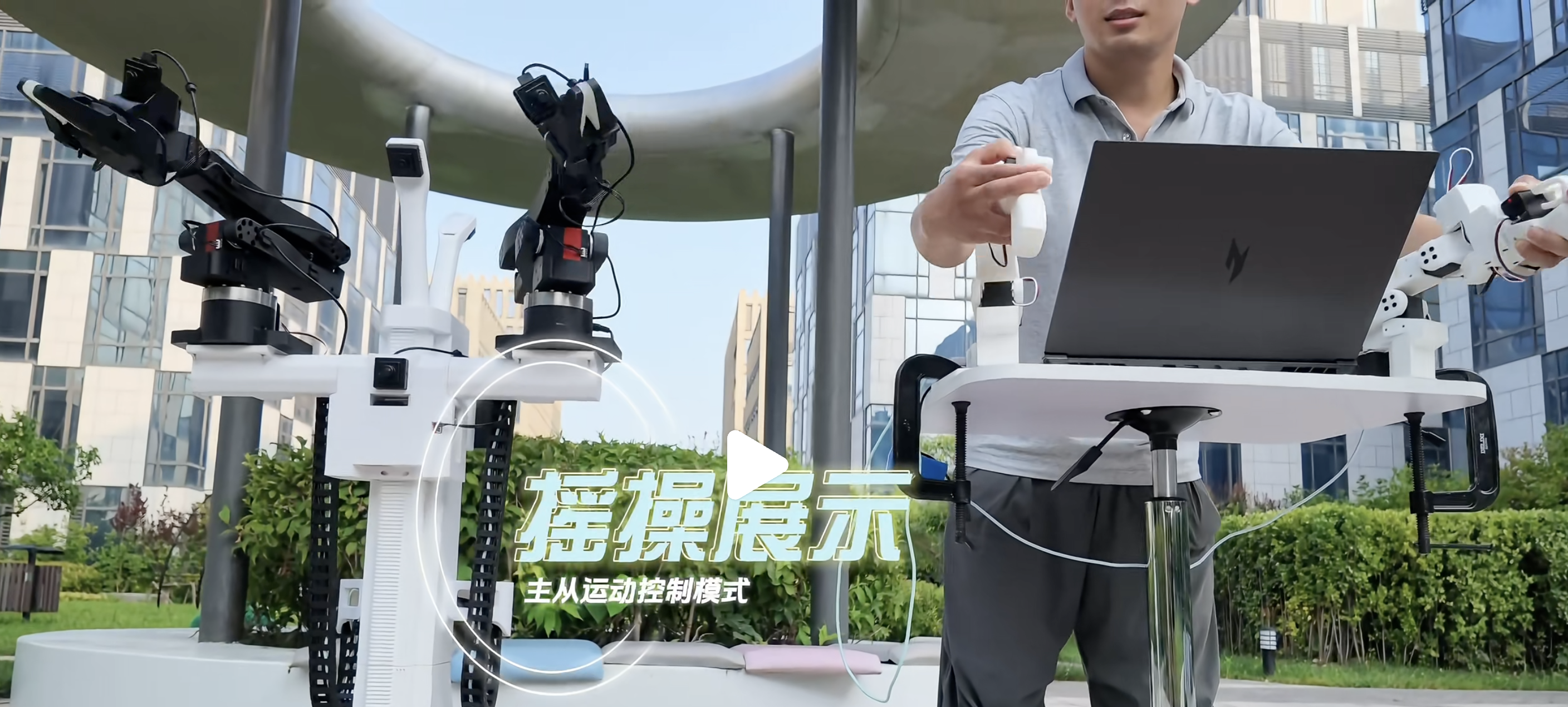
Using a pair of handheld control arms (Leader Arms), students show the AlohaMini how to complete a task.
This process is called “shake operation” or “teleoperation”.
In layman’s terms, it is: Students take the robot to complete a task and tell it “how this thing should be done.”
Step 2: Data collection
While students are demonstrating, AlohaMini will simultaneously record:
How the robotic arm moves;
When does the gripper grab and release items;
What does the camera see?
The sequential steps that a robot goes through while completing a task.
These records constitute the real data required for robot learning tasks, and are the robot’s experience of “what it saw and what it did” in the real environment.
Step 3: Model Learning
Using the collected data, teachers and students can use imitation learning methods such as ACT to let the robot learn task rules.
For example, when the robot sees the target product, the model will learn to judge: should the next step be to approach or grab it? How should I adjust the angle of the robotic arm? Where should it be moved after grabbing?
(Note: ACT is one of the commonly used imitation learning methods in the field of embodied intelligence. It is especially suitable for precise operation tasks such as grabbing and placing.)
Hugging Face’s LeRobot tool system uses ACT as one of the important entry methods for robot imitation learning. LeRobot ACT Documentation
Step 4: Real device verification
After completing model training or inference, teachers and students can run the learning results on AlohaMini to observe whether the robot can autonomously complete similar tasks in real scenarios.
For example, can the robot identify the target item? Is it possible to capture stably? Are you able to put items in the correct location?
Students can intuitively see: where is the boundary of the model’s capabilities, and how will the light, placement, object shape and operating path in the real environment affect the robot’s performance?
Step 5: Iterative optimization
If the robot fails to complete the task, students can analyze why:
Are the number of demonstrations insufficient?
Has the task environment changed too much?
Did the camera see the target object clearly?
Does the placement of items affect grabbing?
Is it necessary to add new demonstration data?
In the process of supplementary demonstrations, environment adjustments and re-testing, students will experience a real engineering and scientific research process:
Ask questions, record evidence, adjust plans, verify results, Continuous improvement .
Through AlohaMini, students can start from “teaching the robot to complete a task” and further understand how data affects the model, how the model affects actions, and how to continuously improve the robot’s task performance through real verification.
In this way, embodied intelligence is no longer just an abstract concept, but a real process that students can personally participate in, observe, and study.
Full-stack ecological adaptation: How does AlohaMini continue to support cutting-edge embodied intelligence practices?#
Embodied intelligence is still in a stage of rapid development, with new open source models, training methods, and development tools constantly emerging.
The value of AlohaMini lies not only in supporting current teaching tasks, but also in providing students with a real robotic platform that can continue to contact, understand and verify cutting-edge technologies.
AlohaMini is deeply compatible with the Hugging Face LeRobot open source tool system.
LeRobot can be understood as a set of open source “tool systems” for robot learning. It connects robot control, data collection, data management, model training, model inference and real machine testing, and provides a relatively unified usage method.
This means that teachers and students do not need to build a complex software environment from scratch for each method, but can carry out learning, testing and innovation in the same practice link based on AlohaMini:
Task design → Shake operation demonstration → Data collection → Model training or inference → Real machine verification → Results improvement
Currently, AlohaMini supports the practice of mainstream imitation learning methods such as ACT, Diffusion Policy, and FastWAM. For beginners, methods such as ACT can help students understand how robots learn to complete tasks such as grabbing, placing, and sorting from human demonstrations.
As the learning progresses, students can also compare the impact of different amounts of data, demonstration methods or learning methods on the robot’s performance around the same task. For example:
Can increasing the number of demonstrations improve the success rate of task completion?
Can the robot continue to complete the task after changing the placement of the items?
Are there differences in the performance of different models in grasping, sorting, or dual-arm collaboration tasks?
How to improve scene design and training data to make robots complete tasks more stably?
These issues can become long-term projects for clubs, or they can be developed into the research content of high school research studies, scientific and technological innovation competitions or thesis papers.
For teachers and students with advanced foundations, AlohaMini can also carry out reproduction, adaptation and real machine testing around open source embodied intelligent models such as Pi-0.5, SmolVLA, EO-1, VLA-JEPA, GR00T N1.7, and EVO1.
When a new open source model has open code, open interfaces, and meets corresponding software and hardware conditions, AlohaMini can be used as a real robot platform to support teachers and students in adaptation, testing, and verification.
Therefore, AlohaMini not only serves a fixed course or a fixed algorithm, but can also support embodied intelligence practices of different depths:
For beginners: Understand how robots learn from human demonstrations;
For clubs and competitions: Data collection, model inference and debugging around real tasks;
Project-oriented research: Compare the impact of data, models and task design on robot performance;
Facing frontier exploration: When conditions are met, bring new open source methods to real robots for verification.
From learning existing methods to verifying new technical ideas; from a classroom experience to continuously accumulating course cases, student projects and research results, AlohaMini provides schools with a path to connect open source technology and real robot practice.
Note: Different open source models have different requirements for computing resources, sensor configurations, software environments and task forms. The specific adaptation range is subject to actual conditions and official technical support plans. *
All software and hardware are open source: How does AlohaMini support students to move from users to creators?#
AlohaMini’s software and hardware are all open source, allowing students to not only use existing functions, but alsoUnderstand, modify and expand the robot’s capabilities around your own topics and ideas.
AlohaMini 1 and AlohaMini 2 have released hardware and software information. Students and teachers with advanced foundations can further modify the mechanical structure, add sensors or end tools, develop new control methods, and build their own robot applications around actual scenarios according to the needs of the topic or project.
Open and expandable content includes:
Mechanical structure design drawings;
Robot digital model and simulation description files;
Low-level control and software support code;
Robot software support and development materials for LeRobot.
Related open source information:
Hardware: AlohaMini open source hardware project
Software: AlohaMini LeRobot software support
From completing a given task to designing new abilities, tools and scenarios for robots, AlohaMini provides a space for students to move from “users” to “creators”.
Creative practices from the open source community
The openness of AlohaMini provides a basis for secondary development by global makers.
At present, many overseas developers can carry out secondary development on the basis of AlohaMini to explore more interesting and real applications.
Case 1
Overseas maker Eric Gradman connected the visual model, Hermes Agent, behavior tree and navigation capabilities to AlohaMini, enabling AlohaMini to interact with people through voice dialogue, build maps and navigate at home, autonomously dock at designated work locations, see and understand the surrounding environment, and even play with dogs using a laser attached to the robotic arm.
This content cannot be displayed outside Feishu documents at the moment.
Case 2
Developer @PgChiyo from the Matsuo Iwasawa Lab of the University of Tokyo upgraded the chassis, battery, gripper, and robotic arm based on AlohaMini.
This content cannot be displayed outside Feishu documents at the moment.
Case 3
Overseas maker Sean combines AlohaMini with SO107 robotic arm and XLeRobot gripper.
This content cannot be displayed outside Feishu documents at the moment.
Case 4
Overseas maker Histochemichael developed a teleoperation solution for AlohaMini: the operator can use 4 foot pedals to control the forward and backward movement of the chassis and the lifting and lowering of the robot, control the steering of the chassis through facial tracking through a computer camera, and use the So101 main operating arm to remotely and synchronously control the movements of AlohaMini’s arms.
This content cannot be displayed outside Feishu documents at the moment.
Case 5
Overseas maker skpro109 configured the so101 robotic arm for AlohaMini, and innovatively used the iPhone camera as a controller to map the movements of the robotic arm.
This content cannot be displayed outside Feishu documents at the moment.
Case 6
Overseas maker kang minkyu upgraded the So101 gripper to solve the problem of grasping large and special-shaped objects, and adapted it to the VLA visual language action model research.
This content cannot be displayed outside Feishu documents at the moment.
Other advantages#
In addition to having real embodied intelligence development capabilities, AlohaMini also lowers the threshold for schools to carry out relevant practices through high cost performance, safe design, robot delivery, and after-sales support
✅High cost performance#
The traditional “mobile chassis + lifting structure + double-arm collaboration” robot platform easily costs hundreds of thousands.
AlohaMini brings this complete configuration into the 10,000-yuan range, allowing schools to cost-effectively configure a real robot platform that can be used for shaking operations, data collection, model training, and real machine verification.
✅Safe design#
Unlike high-torque robots designed for industrial operations, high-speed motion or large-load tasks, AlohaMini uses a low-torque actuator design, which is more suitable for teaching practices such as shaking operations, data collection, and task testing under the guidance of teachers.
High-power, high-torque robots can complete higher-speed and larger-load movements, but may bring higher impact and risks when operating errors, collisions or abnormal control occur. AlohaMini takes human-computer interaction safety and equipment protection into teaching scenarios into design considerations, helping teachers and students conduct repeated explorations on real robots with greater peace of mind.
The equipment has two levels of joint stall protection:
When the grippers encounters abnormal resistance, the system automatically removes the clamping force to reduce the risk of clamping overload;
When the load on the robot arm joint exceeds the set range, the system stops outputting torque to reduce the risk of equipment overload and collision.
4. Application scenarios of AlohaMini in schools#
AlohaMini is committed to becoming a practical platform for schools to carry out embodied intelligent education, research-based learning, club activities, competition training and other activities.
Learn|Understanding Embodied Intelligence#
Students can start by understanding the structure of the robot and gradually understand how the camera helps the robot “see” the environment, how the robotic arm and gripper complete grabbing and placement, and how the mobile chassis and lifting structure help the robot adapt to tasks at different locations and heights.
AlohaMini provides continuously updated official tutorials and development materials to help teachers and students learn from the shallower to the deeper:
AlohaMini_Newbie Tutorial_v1.3 · AlohaMini open source robot
Get to know AlohaMini: Understand the hardware structure, such as arms, camera, chassis, lifting structure and its functions;
Shake operation: Learn shake operations, data collection, etc., and learn to make the robot move
ACT training: The team can provide remote technical support to help complete the first ACT / AM-ACT model training or inference practice, that is, to help the robot complete the first autonomous task
For teachers, supporting materials can help transform cutting-edge technologies into organizeable, explainable, and operable learning activities; for students, they can move from “getting to know a robot” to truly “training a robot to complete autonomous tasks.”
Practice|Personally train the robot#
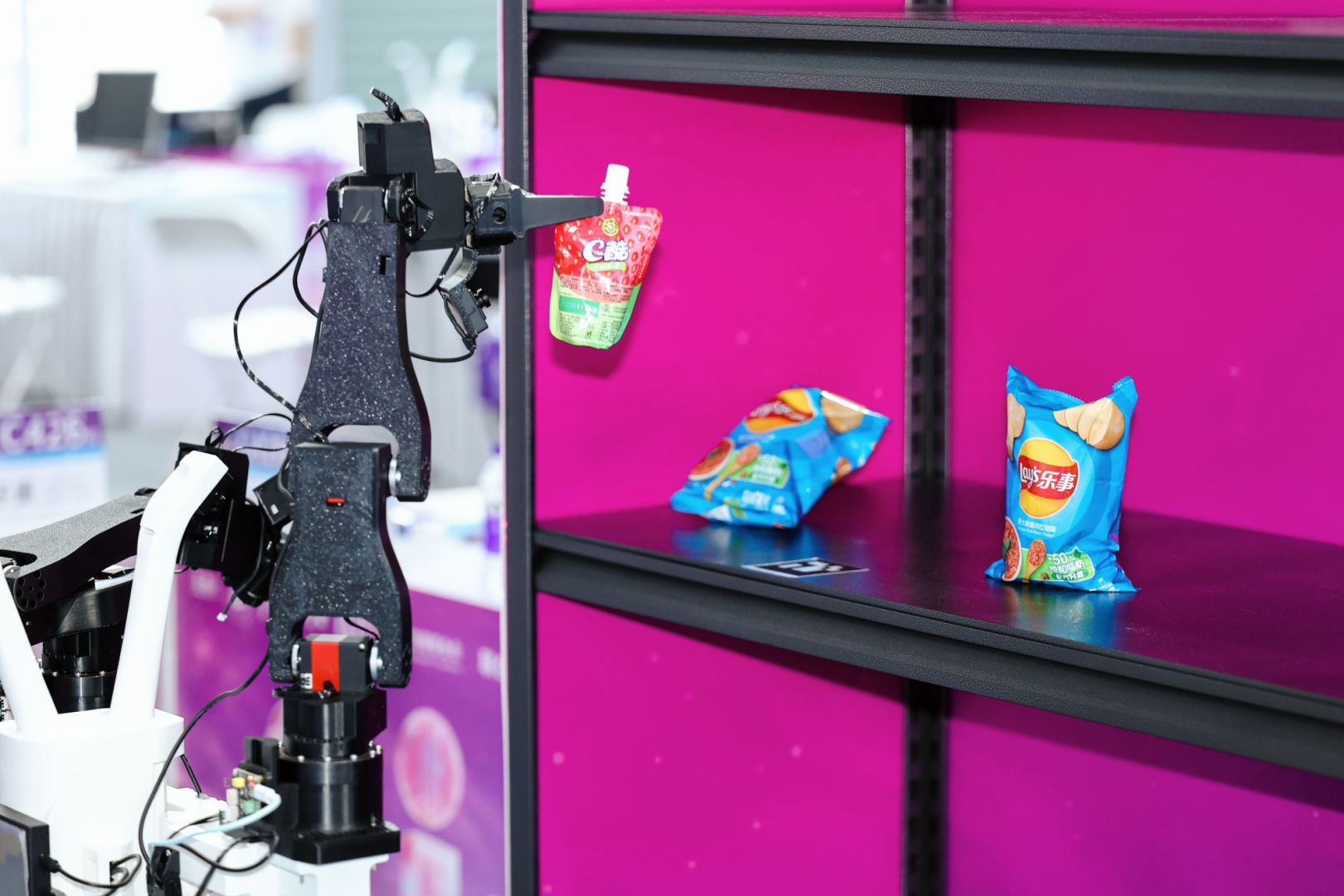
Students can personally demonstrate tasks to the robot through shaking operations, understand how real data is generated, and how the model learns task rules from human demonstrations.
The originally abstract “data collection”, “model training” and “real machine verification” will become practical processes that are operable, observable and repeatable.
Competition|Carry out embodied intelligence preparation for the competition#
Aloha Mini has been used as the machine for the fourth track (embodied intelligence track) of the finals of the first National Youth Artificial Intelligence Competition.
Based on the same platform, schools can organize students to familiarize themselves with processes such as robot operation, task design, data collection and model inference, and carry out daily training and project accumulation around competition tasks.
This content cannot be displayed outside Feishu documents at the moment.
Research|Provides a carrier for research-based learning in high schools#
Students can conduct high school research on a specific issue, such as:
How to make robots sort items more accurately?
How do the number and quality of demonstrations affect a robot’s task performance?
How do camera angles, object placement, or operating paths affect the results?
How to improve the stability of task completion by adjusting data and task environment?
Students can design experiments, collect data, train or test models, analyze results, and formulate research reports or thesis.
Let the subject research move from data collection and concept discussion to real experiments, real data and real verification.
Creation|Support the development of innovative projects#
Artificial intelligence, robotics and science and technology innovation clubs can continue to design new tasks, new scenarios and new interaction methods around themes such as campus object sorting, experimental material sorting, dual-arm collaboration, and smart supermarkets.
Different students can take on roles such as scene design, robot operation, data recording, model testing, experimental analysis and results display, and jointly complete interdisciplinary innovation projects.
Not only learning technology, but also understanding the era that is happening#
The significance of embodied intelligence education is not only to train students who will study science and engineering in the future.
When artificial intelligence moves from the screen to the real world, every student needs to start thinking:
When machines start to think, how will humans get along with them? When algorithms participate in decision-making, how can safety be ensured? When technology challenges ethics, how can governance keep up? When the gap continues to widen, how can inclusive benefits be achieved?
Technical literacy does not mean that every student must become an algorithm engineer. More importantly, students are allowed to form fact-based judgments, ask valuable questions, and participate in future society with a responsible attitude on the basis of understanding the basic principles of technology.
AlohaMini task scenario reference list#
The following tasks can be flexibly selected according to student foundation, course goals and site conditions, and can be used for classroom experience, club projects, research study and competition training.
Scene theme |
Sample Task |
Abilities involved |
Suitable form |
|---|---|---|---|
Desktop organization |
Organize stationery, building blocks or experimental materials into designated areas |
Visual recognition, grabbing, placement |
Introductory experience classes, club activities |
Experimental equipment arrangement |
Pick up and place test tube racks, equipment boxes or experimental materials in designated order |
Two-arm collaboration and process design |
Science courses, comprehensive practice |
Smart supermarket shopping |
Move to the shelf, identify the specified product, grab it and send it to the delivery area |
Mobile navigation, visual recognition, crawling, and transfer |
Competition training and display projects |
Campus Material Delivery |
Pick up the items from the pickup area and move them to the designated area to complete the delivery |
Path planning, mobile pick-and-place, task execution |
Club projects, campus scene design |
Book organization |
Identify designated books or cards to complete picking, placing, sorting and placing |
Visual recognition, dual-arm operation |
Library themed projects |
Garbage sorting simulation |
Identify different categories of simulated waste and put them into corresponding recycling containers |
Classification recognition, capture, environmental protection theme design |
Labor education, science and technology innovation activities |
Low item pickup |
Pick up items from the ground or low places and place them on the desktop or storage rack |
Lift, move, grab |
Basic Robot Practice |
Dual-arm collaborative assembly |
One robotic arm fixes the object, and the other completes plugging, placement or assembly. |
Double-arm cooperation and precise operation |
Advanced courses and research projects |
Human-machine collaboration task |
Students and robots work together to transfer, organize or assemble items |
Human-machine collaboration and division of tasks |
Demonstration classes, club activities |
Independent creative tasks |
Customize scenarios and task rules around campus life |
Scenario design, data collection, model verification |
Research-based learning and innovation competition |
5. Product Lines and Services#
AlohaMini 2 6-axis version#
Positioning: Suitable for makers/individual developers
Price: 12,999 yuan
Delivery form: Parts set + video tutorial + offline assembly experience activity + one-year warranty on key parts + full set of accessories
Core Features:
6+1 degree of freedom robotic arm
1kg load
Official technical support
First level classification |
Parameter item |
AlohaMini2 |
|---|---|---|
Machine parameters |
Overall machine size (standing) |
550 mm × 500 mm × 1200 mm |
Machine parameters |
Overall machine weight |
13.5 kg(±10%) |
Machine parameters |
The total degree of freedom of the whole machine |
18 |
Machine parameters |
Chassis load |
70kg |
Machine parameters |
Lifting module load |
30kg |
Machine parameters |
Wingspan |
About 52cm |
Machine parameters |
Degree of freedom configuration |
Arm 6+1 DOF; lift 1 DOF; chassis 3 DOF |
Machine parameters |
Protection level |
IPX2 |
Machine parameters |
working temperature |
0 ℃ ~ 50 ℃ |
Mobile functionality |
Chassis movement form |
omnidirectional wheel movement |
Mobile functionality |
Chassis freedom |
3 degrees of freedom (X translation, Y translation, in-situ rotation) |
Mobile functionality |
Navigation plan |
Visual SLAM + VLA end-to-end large model |
Mobile functionality |
Sport mode |
Forward, backward, traverse, rotate on the spot |
Mobile functionality |
straight speed |
Nominal 0.2 m/s, maximum 0.5 m/s |
Mobile functionality |
Spin performance |
80 deg/s, 4.5 s to complete 380° rotation |
Mobile functionality |
Minimum passing width |
500 mm |
Mobile functionality |
Maximum seam width |
30 mm |
Mobile functionality |
Maximum obstacle clearance height |
10 mm |
Mobile functionality |
Maximum climbing angle |
≤ 30 ° |
Perception function |
head vision |
Single channel RGB camera |
Perception function |
Head camera field of view |
FOV 150° |
Perception function |
Robotic wrist vision |
Single channel RGB camera |
Perception function |
navigation radar |
None |
Perception function |
Navigation and obstacle avoidance vision |
Pure visual obstacle detection |
Perception function |
PC - Robot image transmission method |
binary streaming |
Perception function |
Single-channel camera bandwidth occupation |
1–1.5 MB/s |
Perception function |
Radar angular resolution |
/ |
Perception function |
Ranging accuracy |
/ |
Perception function |
Measure radius |
/ |
Energy replenishment function |
Battery type |
Lithium battery |
Energy replenishment function |
battery voltage |
12 V |
Energy replenishment function |
battery capacity |
11200 mAh |
Energy replenishment function |
Charging method |
Manual charging |
Energy replenishment function |
Charging rated current |
2 A |
Energy replenishment function |
Manual charging full charge time |
≤ 6 h |
Energy replenishment function |
Battery quantity |
2 groups |
Robot Arm |
Degrees of freedom per arm |
7 DOF (6-axis arm + 1-axis gripper) |
Robot Arm |
Rated load at 0.5 m |
1 kg |
Robot Arm |
Repeatable positioning accuracy of robotic arm (excluding gripper) |
±2 ~ 5 mm |
Robot Arm |
Maximum reach distance (excluding jaws) |
520 mm |
End robot |
Gripper type |
Two-finger electric gripper with wrist-mounted RGB camera |
Electronic control module |
Overall battery life |
≥ 8 h |
Electronic control module |
onboard computing unit |
Raspberry Pi 5 |
Electronic control module |
Leader arm power supply |
Dual independent 5V batteries |
Other functions |
Secondary development support |
Have |
Other functions |
teleoperation function |
Have |
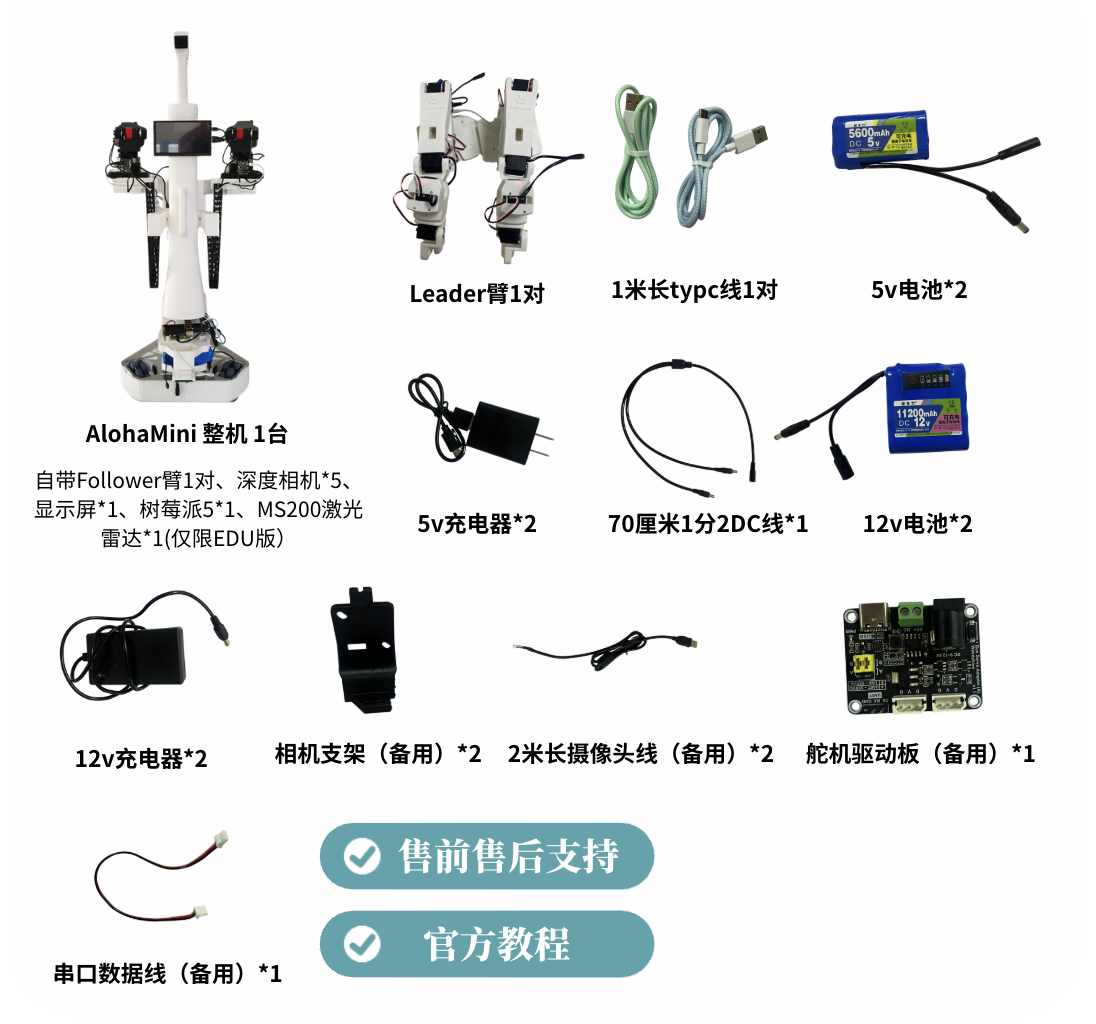
🧾Delivery list#
Serial number |
Category |
Item name |
Quantity |
|---|---|---|---|
1 |
The whole machine |
AlohaMini Parts Kit |
1 unit |
2 |
Rocking arm |
Leader arm |
1 pair |
3 |
power supply |
5V battery |
2 pieces |
4 |
power supply |
5V charger |
2 |
5 |
power supply |
12V battery |
2 pieces |
6 |
power supply |
12V charger |
2 |
7 |
Wire |
1 meter Type-C cable |
1 pair (2 pieces) |
8 |
Wire |
70 cm 1 min 2 DC cord |
1 root |
9 |
Spare parts |
camera stand |
2 |
10 |
Spare parts |
2 meters long camera cable |
2 roots |
11 |
Spare parts |
Servo drive board |
1 piece |
12 |
Spare parts |
Serial data line |
1 root |
🔩After-sales support#
✅One-year official warranty on key parts
✅Official technical support
🏫Official course#
✅Assembly tutorial video
✅Offline assembly experience activities
✅Continuously updated tutorials and development materials
6. Partners#
Beijing University of Aeronautics and Astronautics#
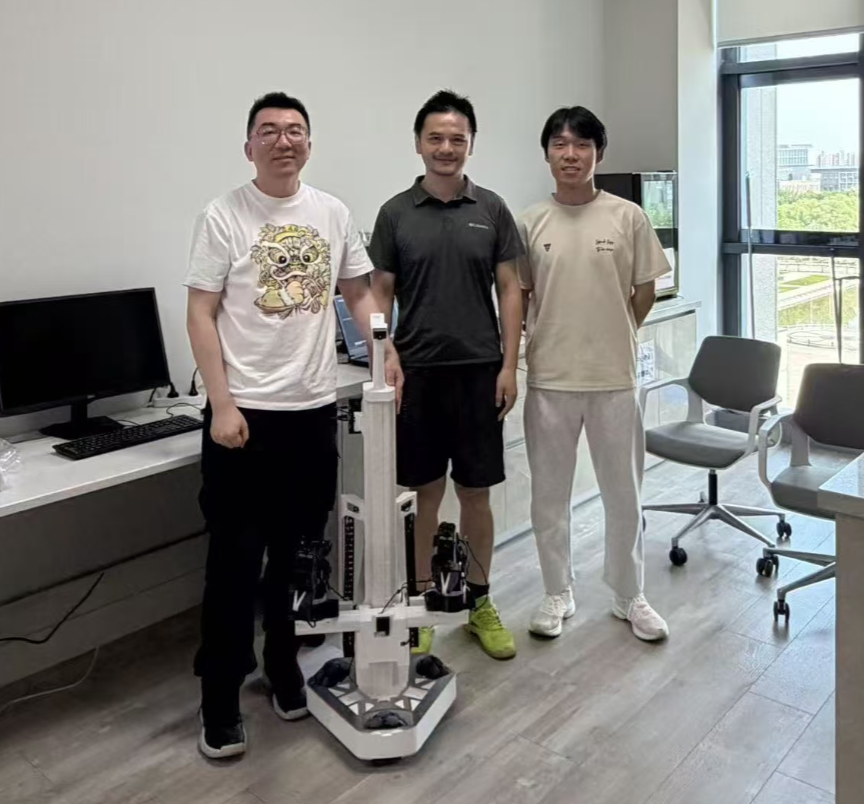
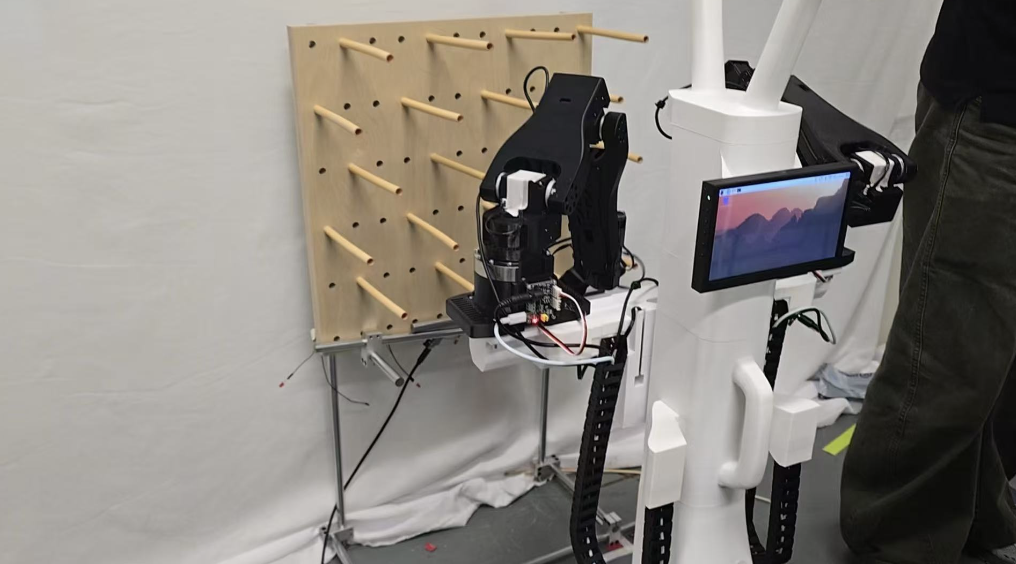
Tongji University#
Explore the application of embodied intelligence in construction
SenseTime#
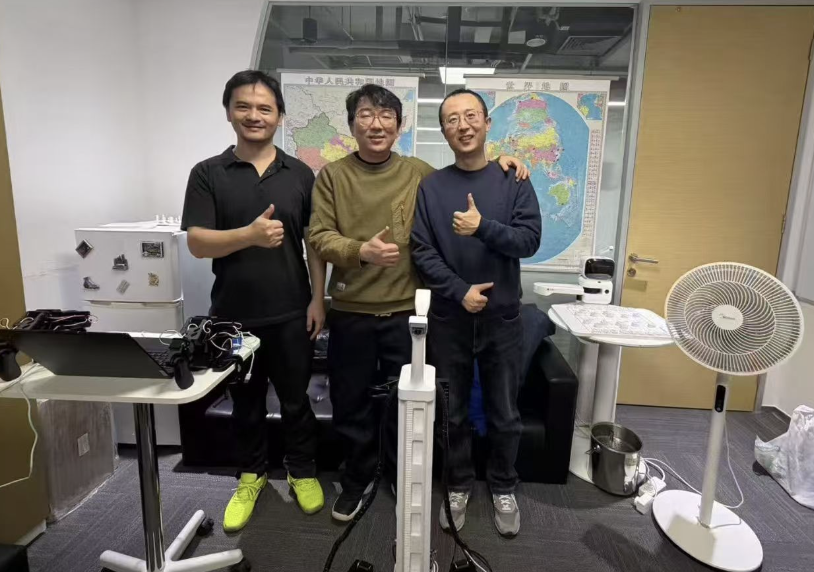
Tech University of Korea#
The machine used in the finals of the first Youth Artificial Intelligence Competition#
https://mp.weixin.qq.com/s/j2BPUJPS7sevqlyFcFjN1A
Former chief scientist of Tesla Optimus likes and reposts! Supported by the founder of Physical Intelligence! Officially endorsed by LeRobot!#
https://mp.weixin.qq.com/s/R8I1cuZSvrYxrAkVJACwvw
7. Contact information#
If you want to purchase a complete set of equipment, please add WeChat to learn more about the details and support services of the AlohaMini finished machine.
GitHub: liyiteng/AlohaMini
WeChat: alohamini2077
Address: Room 303, Floor 3, Building 15, No. 3, Jinghai 5th Road, Beijing Economic and Technological Development Zone (Tongzhou), Beijing