π₀-FAST (Pi0-FAST)#
← 教程资料库 · 策略与模型
本节介绍 LeRobot 的通用功能。请按目标机器人、数据集和运行环境配置示例;用于 AlohaMini 2 / 2 Pro 前,需要确认硬件与接口兼容性。
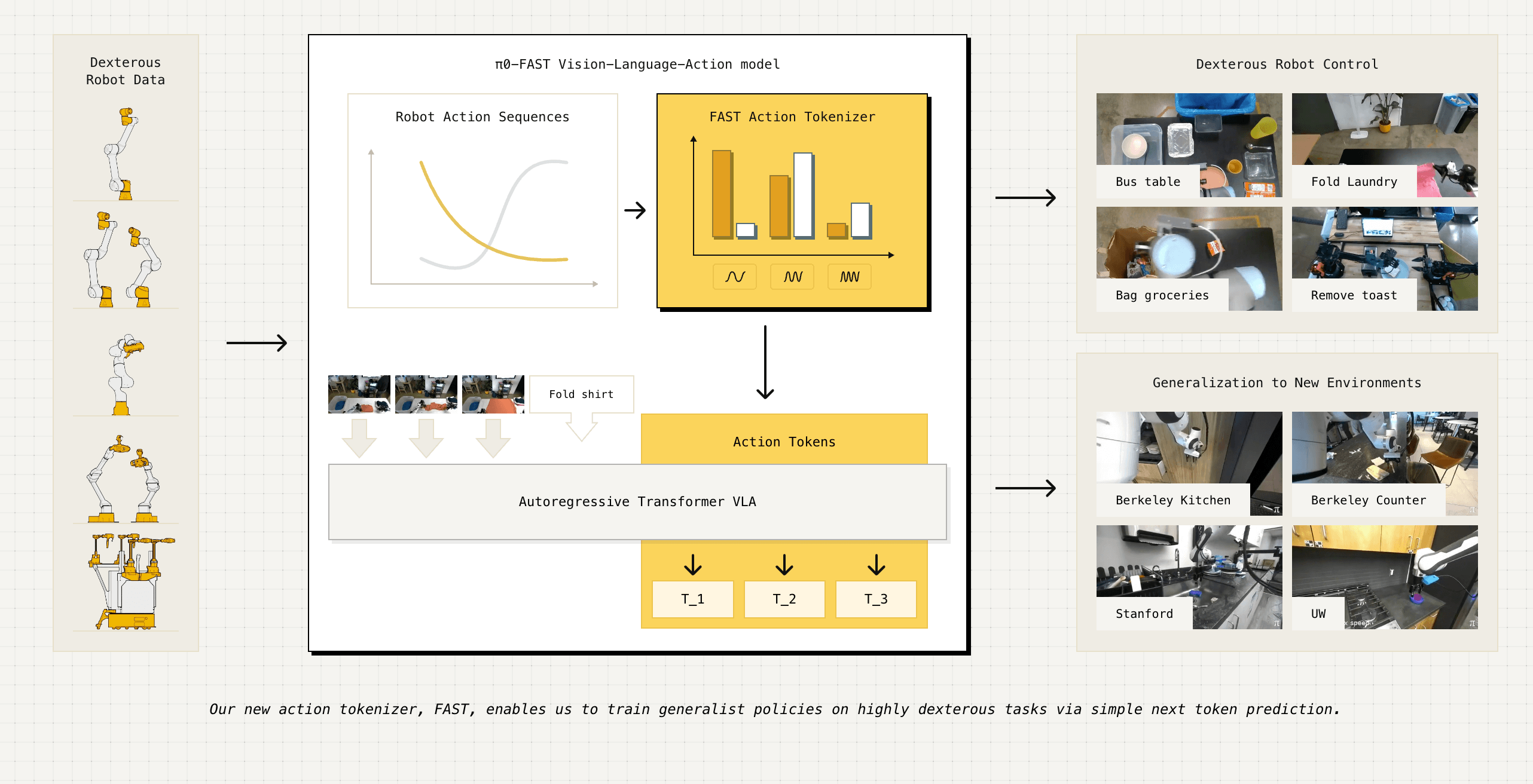
π₀-FAST is a Vision-Language-Action model for general robot control that uses autoregressive next-token prediction to model continuous robot actions.
Model Overview#
π₀-FAST combines the power of Vision-Language Models with a novel action tokenization approach called FAST (Frequency-space Action Sequence Tokenization). This enables training autoregressive VLAs on highly dexterous tasks that are impossible with standard binning-based discretization, while training up to 5x faster than diffusion-based approaches like π₀.
Why FAST?#
Standard approaches for robot action tokenization use simple per-dimension, per-timestep binning schemes. While passable for simple behaviors, this rapidly breaks down for complex and dexterous skills that require precision and high-frequency control.
FAST solves this by compressing action sequences using signal processing techniques, resulting in a dense sequence of action tokens that can be predicted autoregressively—just like language tokens.
How FAST Tokenization Works#
The FAST tokenizer compresses action sequences through the following steps:
Normalize: Take a continuous action chunk of shape
(H, D)whereHis the horizon andDis the action dimension. Normalize using one of the supported normalization methods (Quantiles recommended to handle outliers).Discrete Cosine Transform (DCT): Apply DCT (via scipy) to each action dimension separately. DCT is a compression algorithm commonly used in image and audio codecs (JPEG, MP3).
Quantization: Round and remove insignificant coefficients for each action dimension, producing a sparse frequency matrix.
Flatten: Flatten the matrix into a 1D vector, with low-frequency components first.
Byte Pair Encoding (BPE): Train a BPE tokenizer to compress the DCT coefficients into dense action tokens, typically achieving 10x compression over prior tokenization approaches.
This approach can transform any existing VLM into a VLA by training it to predict these FAST tokens.
Installation Requirements#
Install LeRobot by following our Installation Guide.
Install π₀-FAST dependencies by running:
pip install -e ".[pi]"
Training a Custom FAST Tokenizer#
You have two options for the FAST tokenizer:
Use the pre-trained tokenizer: The
lerobot/fast-action-tokenizertokenizer was trained on 1M+ real robot action sequences and works as a general-purpose tokenizer.Train your own tokenizer: For maximum performance on your specific dataset, you can finetune the tokenizer on your own data.
Training Your Own Tokenizer#
lerobot-train-tokenizer \
    --repo_id "user/my-lerobot-dataset" \
    --action_horizon 10 \
    --encoded_dims "0:6" \
    --vocab_size 1024 \
    --scale 10.0 \
    --normalization_mode QUANTILES \
    --output_dir "./my_fast_tokenizer" \
    --push_to_hub \
    --hub_repo_id "username/my-action-tokenizer"
Key Tokenizer Parameters#
Parameter |
Description |
Default |
|---|---|---|
|
LeRobot dataset repository ID |
Required |
|
Number of future actions in each chunk |
|
|
Comma-separated dimension ranges to encode (e.g., |
|
|
BPE vocabulary size |
|
|
DCT scaling factor for quantization |
|
|
Normalization mode ( |
|
|
Fraction of chunks to sample per episode |
|
Usage#
To use π₀-FAST in LeRobot, specify the policy type as:
policy.type=pi0_fast
Training#
For training π₀-FAST, you can use the LeRobot training script:
lerobot-train \
    --dataset.repo_id=your_dataset \
    --policy.type=pi0_fast \
    --output_dir=./outputs/pi0fast_training \
    --job_name=pi0fast_training \
    --policy.pretrained_path=lerobot/pi0fast-base \
    --policy.dtype=bfloat16 \
    --policy.gradient_checkpointing=true \
    --policy.chunk_size=10 \
    --policy.n_action_steps=10 \
    --policy.max_action_tokens=256 \
    --steps=100000 \
    --batch_size=4 \
    --policy.device=cuda
Key Training Parameters#
Parameter |
Description |
Default |
|---|---|---|
|
Reduces memory usage significantly during training |
|
|
Use mixed precision training for efficiency |
|
|
Number of action steps to predict (action horizon) |
|
|
Number of action steps to execute |
|
|
Maximum number of FAST tokens per action chunk |
|
|
FAST tokenizer to use |
|
|
Enable torch.compile for faster training |
|
Inference#
KV-Caching for Fast Inference#
π₀-FAST supports KV-caching, a widely used optimization in LLM inference. This caches the key-value pairs from the attention mechanism, avoiding redundant computation during autoregressive decoding.
# KV-caching is enabled by default
policy.use_kv_cache=true
Inference Example#
from lerobot.policies.pi0_fast import PI0FastPolicy, PI0FastConfig

# Load the policy
policy = PI0FastPolicy.from_pretrained("your-model-path")

# During inference
actions = policy.predict_action_chunk(batch)
Model Architecture#
π₀-FAST uses a PaliGemma-based architecture:
Vision Encoder: SigLIP vision tower for image understanding
Language Model: Gemma 2B for processing language instructions and predicting action tokens
The model takes images, text instructions, and robot state as input, and outputs discrete FAST tokens that are decoded back to continuous actions.
Configuration Options#
Parameter |
Description |
Default |
|---|---|---|
|
VLM backbone variant ( |
|
|
Maximum state vector dimension (padded) |
|
|
Maximum action vector dimension (padded) |
|
|
Sampling temperature (0.0 for greedy) |
|
|
Maximum decoding steps |
|
|
Enable KV caching for faster inference |
|
Comparison with π₀#
Feature |
π₀ |
π₀-FAST |
|---|---|---|
Action Representation |
Flow Matching (Diffusion) |
Autoregressive Tokens (FAST) |
Training Speed |
1x |
5x faster |
Dexterity |
High |
High |
Inference Method |
Iterative Denoising |
Autoregressive Decoding |
KV-Caching |
N/A |
Supported |
Reproducing π₀Fast results#
We reproduce the results of π₀Fast on the LIBERO benchmark using the LeRobot implementation. We take the LeRobot PiFast base model lerobot/pi0fast-base and finetune for an additional 40kk steps in bfloat16, with batch size of 256 on 8 H100 GPUs using the HuggingFace LIBERO dataset.
The finetuned model can be found here:
π₀Fast LIBERO: lerobot/pi0fast-libero
With the following training command:
lerobot-train \
  --dataset.repo_id=lerobot/libero \
  --output_dir=outputs/libero_pi0fast \
  --job_name=libero_pi0fast \
  --policy.path=lerobot/pi0fast-base \
  --policy.dtype=bfloat16 \
  --steps=100000 \
  --save_freq=20000 \
  --batch_size=4 \
  --policy.device=cuda \
  --policy.scheduler_warmup_steps=4000 \
  --policy.scheduler_decay_steps=100000 \
  --policy.scheduler_decay_lr=1e-5 \
  --policy.gradient_checkpointing=true \
  --policy.chunk_size=10 \
  --policy.n_action_steps=10 \
  --policy.max_action_tokens=256 \
  --policy.empty_cameras=1 \
We then evaluate the finetuned model using the LeRobot LIBERO implementation, by running the following command:
tasks="libero_object,libero_spatial,libero_goal,libero_10"
lerobot-eval \
  --policy.path=lerobot/pi0fast-libero \
  --policy.max_action_tokens=256 \
  --env.type=libero \
  --policy.gradient_checkpointing=false \
  --env.task=${tasks} \
  --eval.batch_size=1 \
  --eval.n_episodes=1 \
  --rename_map='{"observation.images.image":"observation.images.base_0_rgb","observation.images.image2":"observation.images.left_wrist_0_rgb"}'
Note: We set n_action_steps=10, similar to the original OpenPI implementation.
Results#
We obtain the following results on the LIBERO benchmark:
Model |
LIBERO Spatial |
LIBERO Object |
LIBERO Goal |
LIBERO 10 |
Average |
|---|---|---|---|---|---|
π₀-fast |
70.0 |
100.0 |
100.0 |
60.0 |
82.5 |
The full evaluation output folder, including videos, is available here
License#
This model follows the Apache 2.0 License, consistent with the original OpenPI repository.
References#
FAST: Efficient Robot Action Tokenization - Physical Intelligence Blog
OpenPI Repository - Original implementation
FAST Tokenizer on Hugging Face - Pre-trained tokenizer